Mine Ownership Models
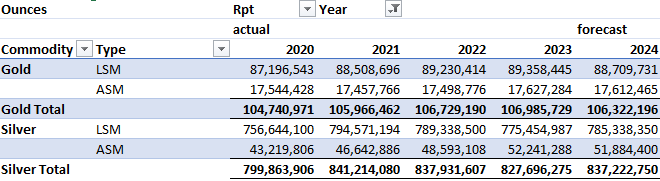
Broadly, mine ownership of precious metals production, over the last five years, can be split between: large scale mining (LSM) and artisanal and small-scale mining (ASM).
Mine Ownership Type
A more refined lens on precious metals mine ownership is can be defined by type, size or focus:
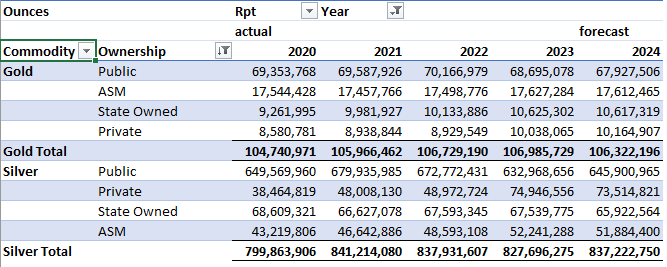
- by ownership type: public, private, state-owned enterprises, and artisanal and small-scale mines (ASM),
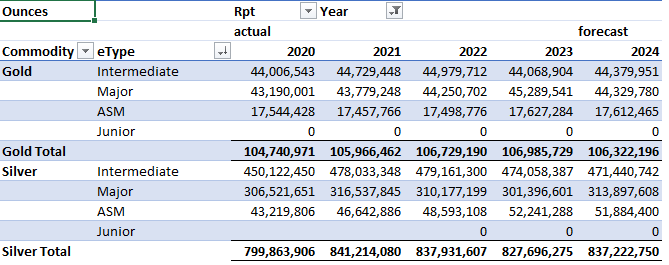
- by ownership size: majors, intermediates and asm (juniors , by definition, have no production),
- by ownership focus: primary or secondary producers (for LSM whether precious metals are a primary or secondary output, and for ASM, either artisanal or small-scale),

Artisanal and Small-Scale Mining
Artisanal and small scale mining gold production (ASM) is mining which takes place usually on an informal basis.
Specifically, artisanal mining means using largely manual labour. Small-scale mining, on the other hand, uses mechanical methods of extraction.
Generally, small scale mining is larger and more mechanised than artisanal but, at the same time, smaller and less industrial than large scale mining.
Production in each “artisanal zone” is assumed not to change much from year to year, unless there is a major event like a gold rush or some sort of natural or man-made disaster.
Even at the recently elevated price of silver, typically artisanal silver mining is not economic. This may change in the near future. Silver is sometimes produced as a result of artisanal gold mining and is not usually the primary focus.
Small scale silver mining does take place, namely in: Bolivia, Peru, China, Russia and Mexico.